Most lost-cat stories don't start with the cat bolting out the front door. They start with a screen that was always a little loose, a delivery driver holding the gate open for a second too long, or a window the cat had been studying for weeks. By the time you notice the silence, your cat has been gone five minutes — or five hours. Either way, what you do in the next 48 hours matters far more than anything you'll do in the week that follows.
This is the playbook we wish every Filipino cat parent had bookmarked before they needed it.
The first thing to understand: cats don't run away. They hide.
This is the single most important sentence in this guide. Almost everything else flows from it.
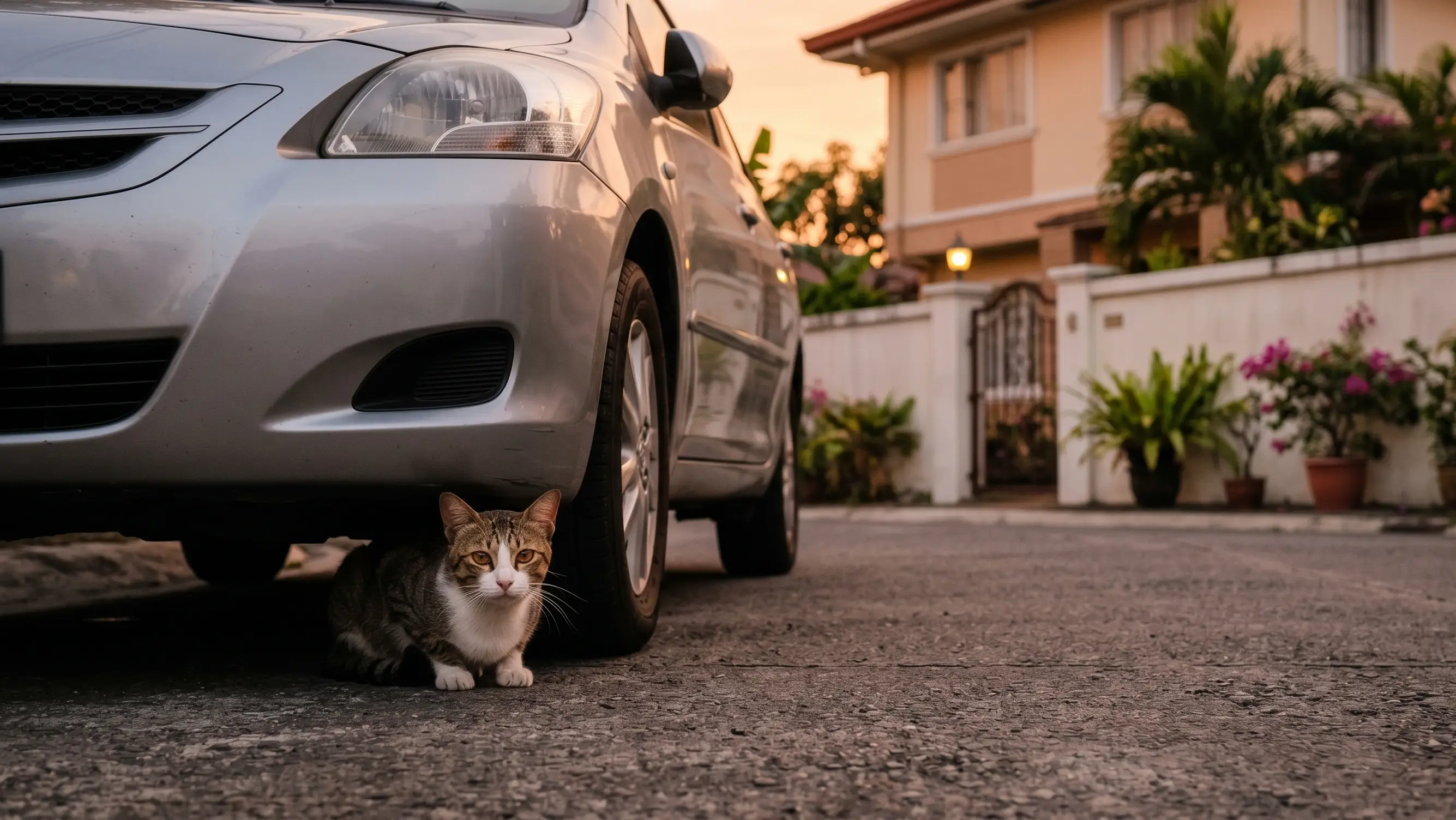
A dog who escapes will usually keep moving — they follow smells, chase squirrels, and end up two kilometers away in three hours. A cat who escapes does almost the opposite. They find the nearest tight space and freeze. Rescue communities here and abroad consistently report the same pattern: the majority of lost cats are recovered within 500 meters of where they went missing, and a meaningful share are found hiding on the owner's own property — under a parked car, in a back garden, in a storage room with a door that didn't fully close.
If your cat just disappeared, you are not looking for a moving target. You are looking for a small, scared animal who has wedged themselves into the smallest dark space they could find within sight of home.
That changes how you search.
The first 30 minutes — quiet, close, methodical
What most pet parents do in the first 30 minutes — calling out the cat's name loudly, sending the whole family running through the subdivision, driving around the block — is the exact opposite of what works for cats. A frightened cat hears panic and goes further into hiding, not toward the voice.
Here's what to do instead.
Don't:
- Shout for them. Your tone in distress sounds nothing like your tone at dinnertime.
- Send a search party of four people stomping around the perimeter.
- Drive around looking — you will almost certainly miss them, and the engine noise pushes them deeper into hiding.
Do:
- Open every door and window in the house. Many cats come back on their own once the panic of the outdoors hits them.
- Place the litter box just outside the door, plus a piece of clothing you've been wearing today. The smell is a homing signal — for cats it's far stronger than sight.
- Shake the dry-food bag or the treats container at the doorway. That sound is one of the deepest reflexes in a domestic cat's brain.
- Walk slowly around your own property and within 50 meters. Look under your car, under the neighbor's car, behind potted plants, in any gap under a building or storage shed. Use a flashlight even in daylight — a cat's eyes reflect from deep in a dark space when nothing else gives them away.
Keep it slow. Stop every few meters and listen.
Hours 1 to 3 — expand the radius, but stay calm
The next two to three hours are still about quiet, focused searching, not online posting. Most cats are found in person, not via Facebook.
Walk a careful spiral outward from your door. The radius to cover in this window is roughly 200 meters in each direction — almost never further. Bring their food container so you can pause every few meters and shake it gently. The sound carries further than your voice will.
What you're looking for is not the cat in plain sight. You're looking for:
- The space under every parked car within reach
- Storm drains and the gaps where they meet the curb
- Hedges and the bases of large potted plants
- Open garages, especially if a neighbor's gate was open earlier
- Storage rooms, generator sheds, the underside of stilt houses, attic vents
- The eaves of any nearby building — cats climb when they panic
While you walk, talk to the people who actually see your street every day. In a Filipino neighborhood that almost always means three groups:
- Security guards at subdivision and condominium gates. They see every animal that walks through.
- Sari-sari store owners. They sit outside all day and notice everything.
- The kasambahay network. Domestic helpers in nearby compounds chat across the wall constantly. Mention your missing cat to one and within an hour, every nearby household will know.
Bring a clear printed photo on your phone or a tiny printout. People are much more helpful when they can match a face, not just a description.
Hours 4 to 12 — the food station and the first wave of flyers
By this point your cat has probably found their hiding spot and is unlikely to come out until dawn or dusk. This is the moment to set up infrastructure.
Build a comfort station just outside your door. This is the most under-used trick in finding a lost cat:
- Their actual food bowl with their usual dry food — the brand smell matters
- A small bowl of water
- The litter box you've already moved outside (scent signal #1)
- A worn t-shirt or their bed (scent signal #2)
- A cardboard box on its side as shelter if it's raining
Refresh the food every evening for at least the first 7 days. Many indoor cats will sneak out at 3 a.m., eat, and disappear back into hiding for another day — and you'll only realize they came back when you notice the food gone in the morning. Some people set up a basic phone or pet-cam pointed at the bowl. That single trick has reunited a lot of cats with their families.
Now print the flyer. If you have a Pawdex Pro plan, use the Pawdex Lost Pet Flyer maker — it pulls the photo, breed, and barangay directly from your pet's passport so the layout is consistent and quick. Either way, your flyer needs:
- A clear front-facing photo. Not a sleepy side shot.
- Your cat's name. (The myth that hiding the name protects you doesn't hold up — a name plus a clear photo is what makes a stranger confident enough to call you.)
- Last seen: time, barangay, and a recognizable landmark.
- Color, breed, and distinguishing marks. This matters more for cats than dogs because so many local cats are similar-looking puspins. "White paws, kink at the tip of the tail, slight notch in the left ear" turns a generic sighting into a real one.
- Indoor or outdoor cat. People treat the report differently.
- Microchip yes or no. Most PH cat owners haven't done it; that's fine, just say so.
- Pawdex code if you have one.
- Your phone, or a friend's if you're worried about scam calls.
- A small reward note. ₱500-₱1,000 is sensible. Big rewards attract scammers more than they attract sincere callers.
Where the flyers go in the first wave:
- Every sari-sari store within 500 meters
- Every vet clinic within a 5 km radius — vets do scan stray cats brought in, and they often have a corkboard of local lost pets
- The guard houses of nearby subdivisions and condos
- The barangay hall (some maintain a small lost-pet board)
- Local cat rescue groups in your city if you can reach them on the day
The dawn and dusk window — the most important hours of every day
If you remember nothing else from this article, remember this.
Cats are crepuscular. They are most active at dawn and at dusk, which means a lost cat is most likely to come out from hiding to eat, drink, and move around in the 90 minutes around sunrise (roughly 5:00 to 6:30 a.m.) and again around sunset (roughly 5:30 to 7:00 p.m.). The rest of the day they are silent and invisible.
For the first 7 days, make these two windows non-negotiable. Walk out with a flashlight and the food container at sunrise and at sunset, every single day. Sit quietly in your yard at the food station if you can. Cats remember voices — your normal, calm dinnertime voice is the sound that's most likely to coax a frightened cat out of a hedge.
Many cat owners we've talked to in Quezon City, Davao, and Iloilo say the same thing — their cat came home at 5 a.m. on day 4, or wandered up to the food bowl at dusk on day 8. The reunion almost never happens at 2 p.m.
Within 24 to 48 hours — the online and community blast
Posting online matters for cats, but it's a smaller part of the strategy than it is for dogs. Cats are much less likely to be picked up by a stranger — most strangers can't even reliably catch a frightened cat — so the Facebook post is really there to alert people who might spot your cat in their yard or hear them at night.
Post in the cat-specific Filipino groups first:
- Lost and Found Cats Philippines
- Cats of Manila / Cats of Cebu / Cats of Davao (whichever fits)
- Your barangay or subdivision Facebook group
- Pet Lover's Philippines (general but still useful)
How to write the post:
- 3 or 4 clear photos showing the cat's color, markings, and size
- Headline:
LOST CAT — [Name] — [Date] — [Barangay] - Facts: indoor or outdoor, breed or "puspin," distinguishing marks
- Behavior note: "She is shy and will not come to strangers. Please do not chase. Please call me and I will come."
- Your phone number, at the bottom
That behavior note matters. A stranger who corners and chases a panicked cat almost always loses the cat — and now the cat is hiding somewhere new, further from home. The post should make people understand that "spot and call" is the only thing they need to do.
If your cat is on Pawdex, flip on Lost Mode from your dashboard. The QR tag on the collar (if they wear one) flashes a LOST banner and emails you with the city of every scan. Your cat also appears on Pawdex's public lost-pets directory — a single page that lists every Filipino dog and cat currently in Lost Mode, which other users browse and share when they spot a stray. Even for indoor cats who never wore a collar, the digital passport at mypawdex.com/p/PDX-... is a clean way to share their photo and your contact in a single link you can drop into any chat or Facebook post.
Days 2 to 7 — patience, consistency, and a few more physical visits
Most found cats turn up within 5 to 10 days. The window from day 2 to day 7 is when most reunions happen. Your job in this stretch is to keep the system running and not lose patience.
Daily:
- Refresh the food station at sunset
- Walk the dawn and dusk rounds with a flashlight and food
- Check the litter box for signs the cat came by overnight
Every 2 to 3 days:
- Refresh the Facebook post. A new post performs better than bumping the old one.
- Visit the vet clinics within 5 km in person. Many take in strays and won't always think to call the lost-pet list — a face-to-face check is more reliable.
- Walk a fresh sweep through a slightly wider radius — 500 meters out from the previous edge.
By day 4 or 5:
- Visit PAWS Philippines and CARA Welfare in person if you're in their service area, and any local cat rescues in your city.
- Knock on doors, specifically the houses with garages, basements, storage sheds, or any building with a gap underneath. So many PH cat reunions happen because a neighbor's helper or gardener finally noticed a cat sleeping behind the bicycles or under the staircase.
Don't give up at day 7. Cats who were too scared to come out for the first week often emerge in week 2 or 3, when hunger or thirst finally overrides the fear of moving. We've heard stories of cats coming home at week 4 from a Makati condo subdivision and at week 6 from a household in Cebu City. The flyer should stay up. The food station should stay running.
Red flags and scams — short version
A few scam patterns we've seen often enough that they're worth listing:
- "I found your cat — send GCash to cover vet bills before I tell you where." Real finders don't ask for money up front. Walk away.
- "Send me your home address and I'll bring the cat over." Meet at a vet clinic or a barangay hall.
- Anyone who refuses to send a current photo of the cat with today's date.
- Anyone who can't answer a question only you would know — a unique marking, the color of the collar, where the chip was implanted.
A small, modest reward in the flyer (₱500 to ₱1,000) tends to attract honest callers without inviting scammers. Big eye-catching rewards tend to do the opposite.
What NOT to do
A short list of well-intentioned mistakes that we see often:
- Don't chase if you spot them. Even if it's clearly your cat. A frightened cat will bolt straight away from a running human and you may not see them again for days. Crouch down, talk calmly, put food on the ground, and let them come to you.
- Don't post your full home address publicly. Barangay and a landmark are enough for a real finder.
- Don't take the flyers down at the one-week mark. Many reunions happen later than that.
- Don't search loudly. A search party of 4 people calling "kitty kitty" through the subdivision drives your cat deeper into hiding. Quiet, slow, dawn-and-dusk is the strategy.
- Don't give up after a sighting that doesn't end in a recovery. A "someone saw her on Tuesday near the bakery" is a real data point. Walk that area at sunrise the next morning with food.
Prevention — the layer that costs almost nothing
Most cats who get lost are first-time escapees from homes that didn't think the escape was possible. So the prevention layer is mostly about treating a future escape as a "when," not "if."
A few things worth doing now, today, while everyone in the family is still vigilant:
- Mesh window screens on any window the cat watches from. They are cheap on Shopee and Lazada, and a cat who has been planning to push a loose screen for months will finally succeed when no one is watching.
- A door routine for deliveries. The most common single cause of indoor-cat escapes here is the moment when the rider hands over the package. Always close the inside door first, deal with the rider, then open it again.
- A QR collar tag — even on indoor cats. The day they slip out is exactly the day it matters. A clipped breakaway collar with a Pawdex QR tag means anyone with a phone can reach you in seconds, no microchip scanner needed. The QR design itself is free at /pawdex-qr-tag; you only pay for the engraving from a local tag shop.
- A digital passport. Photos, vaccine records, color, distinguishing marks, your contact — all in one scannable URL that updates if your phone number changes. Your first pet's passport is free on Pawdex. Create your cat's passport here.
- Microchipping is still worth doing as a medical-grade backup for vet and shelter scans. It complements the QR tag rather than replacing it — we wrote an honest breakdown of microchipping vs QR tag vs digital passport if you want the full comparison and the PH-specific caveats.
PH-specific resources
- PAWS Philippines — runs a cat adoption arm and accepts lost-and-found reports. PAWS is concentrated in Metro Manila but has nationwide visibility.
- CARA Welfare Philippines — Metro Manila focus, very active community, reachable on Facebook.
- Local rescues — most major PH cities have one or two volunteer rescue groups that specifically work with cats. Search "[your city] cat rescue" on Facebook and message them on day 2 if you haven't found your cat.
- Lost and Found Cats Philippines — the largest cat-specific lost-pet Facebook group in the country at the time of writing. Verify the current membership before posting.
- Your nearest vet clinic — most vets in PH will scan a stray cat brought in. Drop a flyer at every clinic in a 5 km radius.
- Pawdex's public lost-pets directory — every cat (and dog) currently in Lost Mode across the Philippines, in one place. Free to browse, free to share. If your cat is on Pawdex, they appear here automatically the moment you flip Lost Mode on.
The closing thought
Most lost cats DO come home. The Filipino cat community — the rescues, the vets, the kasambahay network, the security guards, the sari-sari store owners — is genuinely helpful when asked clearly and calmly.
If your cat is missing right now, the playbook in a single paragraph: stay quiet, search close before you search wide, set up a food station, do the dawn and dusk rounds religiously, post in the cat-specific groups, talk to the people who actually live on your street, and don't give up at day 7.
And if you ever find yourself reading this because someone else's cat is missing — share the playbook. Quiet, patient searching is the thing that brings them home. Send them to Pawdex's lost-pets directory too; if their cat is on Pawdex, the listing might already be there.
Looking for a lost dog instead? Dogs need a completely different playbook — they wander while cats hide. Read our hour-by-hour lost-dog guide for that side of the story.

Founder of Pawdex. Pet parent to Shimmer and Sigbin. Writes honest pet-care guides for Filipino pet parents — no fluff, real prices, real stories.