Shimmer bolts every chance she gets.
We live in a compound, so the gate has to open often — neighbors leaving in their cars, deliveries, sometimes my brothers in a rush to get somewhere. When it's raining, they don't even step out of the car to close the gate behind them. They just go. And Shimmer, who's almost always out in the yard, takes the opening.
The road is right there.
Every time, my stomach drops the same way. I run to the gate, I call her name, I check the neighbor's yard first, then the street. Years ago we lost another dog to a car. If you've owned a dog in a Philippine compound long enough, you probably don't need me to explain it. The fear is earned.
This article isn't really about the gate, though. It's about the question right after it: when your fur baby actually gets out — what brings them home?
(If you're reading this while your pet is out — close this tab and open the right playbook: hour-by-hour for a lost dog, or day-by-day for a lost cat. They behave completely differently when they're lost, so the search techniques are different too. Come back here for the prevention layer once they're home.)
The honest answer in 2026, in the Philippines, isn't the one most pet parents are sold. So let's walk through it: what's actually available, what each thing actually does, what each thing actually costs, and what works when you're standing on the sidewalk calling a name into traffic.
Your three options as a Philippine pet parent
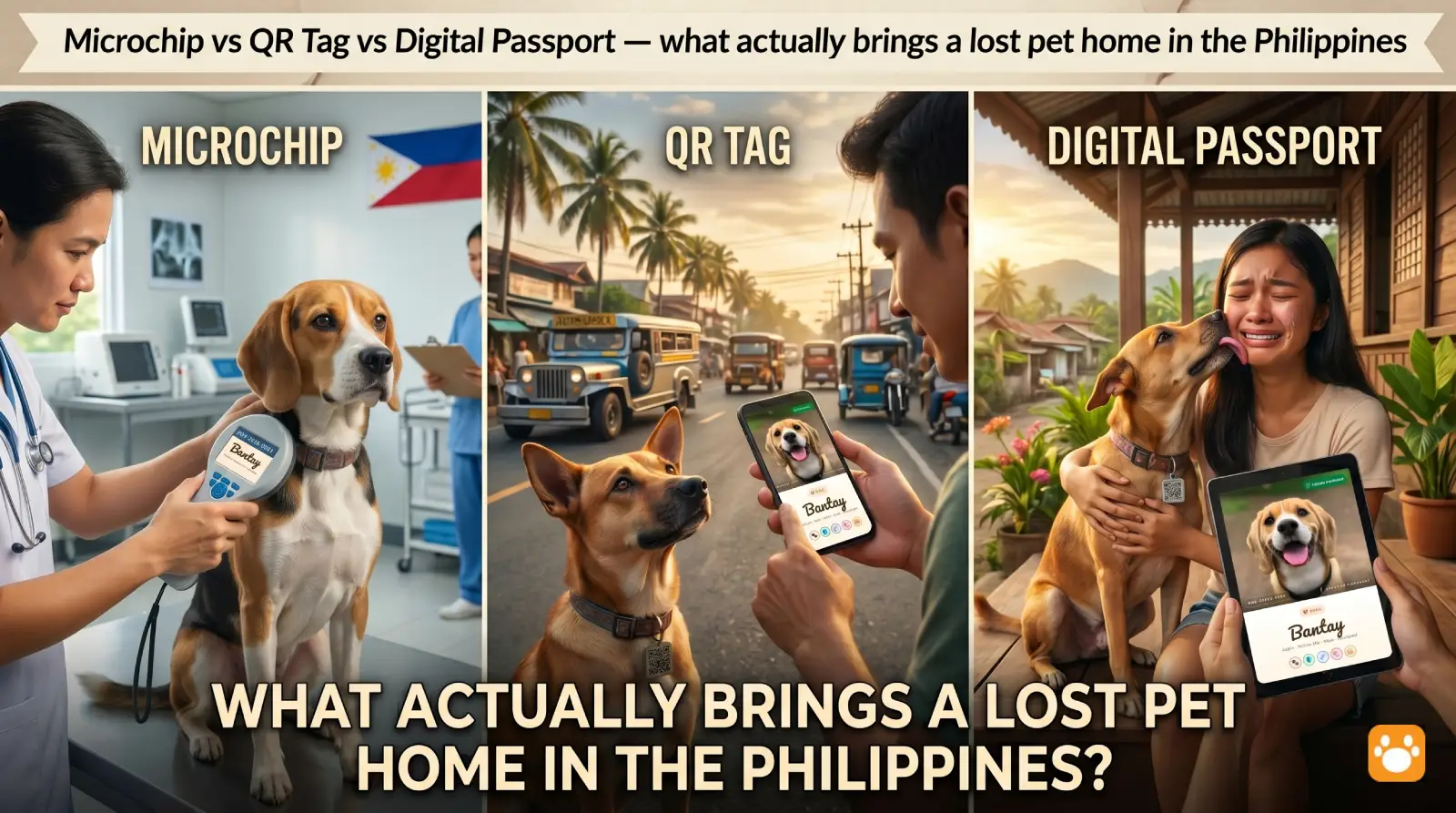
There are basically three things you can do to make your pet identifiable to whoever finds them:
- A microchip — a rice-sized chip implanted under your pet's skin, readable by a vet's scanner
- A QR collar tag — a physical tag on the collar with a QR code (or an engraved phone number)
- A digital pet passport — a cloud-stored profile of your pet that lives independently of any object
These aren't competing products. They solve different parts of the same problem. But almost every Filipino pet parent I've talked to assumes microchipping is the gold standard — and that's where the conversation needs to start, because it's the part most people get wrong.
Microchip — what it actually does (and what it doesn't)
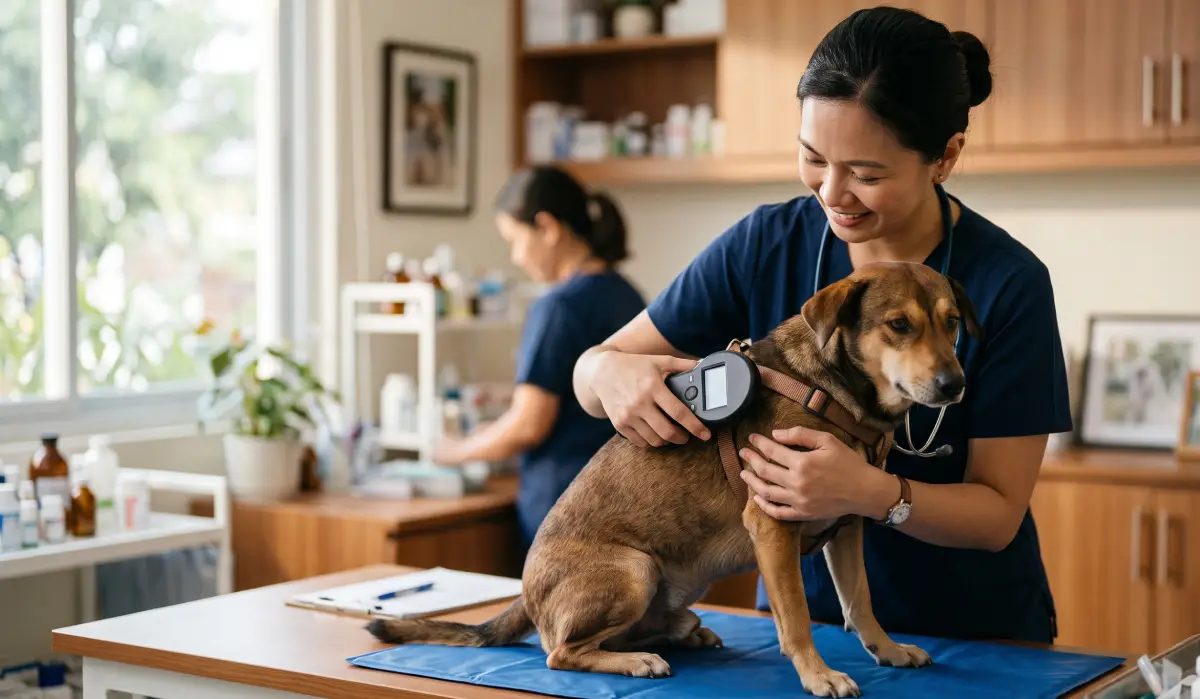
A pet microchip is roughly the size of a grain of rice. A vet implants it under the skin, usually between your pet's shoulder blades, in about 30 seconds. It carries a 15-digit ID number that follows the international ISO 11784/11785 standard. Pass a compatible scanner over it and the number comes up.
What it costs in the Philippines in 2026
Prices range wildly depending on where you go (for a deeper breakdown, see our full guide to pet microchip cost in the Philippines):
- Pet Express clinics: ₱150 for the implant. Easily the cheapest private option if you have a branch near you.
- Most private vets in Cebu and Metro Manila: ₱750 to ₱1,500, including the consult. A typical clinic visit lands around ₱1,000.
- Cebu City DVMF (Department of the Veterinarian and Fisheries): ₱600 for the microchip as an add-on, separate from the ₱200 annual pet registration.
- Mandaue City: ₱100 total for pet registration including lifetime anti-rabies vaccine AND microchip. Easily the best deal in the country if you're in Mandaue.
- Free at the LGU vet office in: Quezon City, Pasig, Davao, Valenzuela, and Makati. These free programs come and go, so check your city's vet office Facebook page for the next scheduled session before you assume they're still running.
So — affordable. Available. Sounds like an obvious yes. But here's where it gets honest.
The thing nobody mentions when they sell you the chip
There's no unified national pet microchip registry in the Philippines.
Records sit fragmented across the implanting vet, private commercial registry systems, and various LGU databases. None of them talk to each other.
That means three things have to happen for your microchipped pet to actually find its way back to you:
- The finder has to bring your pet to a vet. Not a barangay pound, not a friend who works at a pet shop, not the kid who picked up your dog on the corner — a vet with a scanner. A lot of finders won't think of this on their own.
- The vet has to have a compatible scanner. Different microchip manufacturers don't always cross-scan each other's chips. Pet Express's own blog warns about exactly this. Smaller barangay-level clinics often don't have universal readers at all.
- The 15-digit number has to be in a registry the vet thinks to check. If your pet was chipped at a clinic across town and the record only sits in their internal system, a vet in another city has no way to trace it.
Three points of failure. Each one is realistic. None of them are your fault as a pet parent. But they're the reason chipping alone is not the lost-pet recovery silver bullet it's marketed as.
Where microchips genuinely shine: as legal-grade proof of ownership in disputes, for international travel documentation, and as a long-term recovery layer if your pet ends up at a vet who can read the chip and check the right registry. It's a real, useful layer. It's just not the whole stack.
QR collar tag — when the finder doesn't need a vet
A QR collar tag is the physical thing on your pet's collar. There are two flavors:
- Engraved tag with your phone number, your pet's name, or your address. A finder reads it with their eyes. Done.
- QR code tag that, when scanned with any smartphone camera, opens a webpage with your pet's profile and your contact info. No app required.
The second one is the version Filipinos increasingly use, because it does three things an engraved tag can't:
- Your phone number stays current. If you change SIMs, you update the webpage. The tag itself never has to be re-engraved.
- It carries more than a phone number. Pet's name, breed, allergies, your name, a clear "if found please contact" message — even a reward.
- Anyone with a phone is the scanner. A kid who finds your dog at the next corner can pull out their phone and reach you within seconds. They don't need a vet, they don't need a scanner, they don't need to know what a microchip is.
What it costs in the Philippines — and what's free
The Pawdex QR Tag is free. The QR design itself comes with every Pawdex account at no charge — not gated to Pro or Pro+, just included. What you do pay for is the physical engraving: typically ₱200–₱500 at any local tag-maker on Shopee, Lazada, or an in-person engraver. Same shops everyone else uses; your choice of material (laser-engraved stainless steel, brass, or anodized aluminum) and size (collar tags typically run 25–50mm in the Philippines). We don't ship the physical tag — you bring our QR PNG to whichever tag shop you trust, and they engrave it.
If you'd rather buy a plain QR tag off-the-shelf with the seller's pre-designed QR, the Lazada and Shopee market is wide open. Custom engraved tags with their built-in QR designs sit between ₱150 and ₱500, depending on material and engraving quality. Pet Express stocks them in stores. Pawnec.ph sells the IndieTag line online.
The practical difference between the two: a generic QR tag is frozen the day you bought it — change your phone number and the tag becomes useless. A Pawdex QR Tag points to your pet's digital passport, so the contact info stays current forever — change your number once inside Pawdex, every scanned tag picks it up instantly. No re-engraving, ever. It's how Shimmer's collar QR has worked through two phone numbers and a SIM change. Full walkthrough here →
The honest tradeoffs
A QR tag isn't perfect. It has to stay on the collar. Collars can break, fall off in a tussle, or get chewed off by a determined pup. QR codes can fade if the printing is cheap or the tag scrapes against concrete every day.
None of that is fatal. The fix is just: buy a tag with decent durability (laser-engraved metal, not printed plastic), check it once a month, and replace the collar before it frays. Not rocket science.
But the win is real. A QR tag turns every smartphone in your neighborhood into a finder station. That's a fundamentally different recovery flow than "hope my pet ends up at a vet with the right scanner."
Digital pet passport — the records that survive everything
This is the layer Filipino pet parents talk about the least, because it's the newest one. A digital pet passport is a cloud-stored profile of your pet — name, photo, breed, microchip number, vaccinations, allergies, vet visits, weight history, the whole picture. It lives on the internet. You access it from any device, any time. It doesn't depend on a physical object at all.
Here's why I think it matters, from our own life with Shimmer.
In July 2019, she was admitted to Pet Science in Cebu — back when they were still near USC TC, before they relocated — for what we casually called "blood dengue." The actual diagnosis was canine ehrlichiosis, a tick-borne blood parasite that wrecks platelet counts and causes bleeding that looks similar to human dengue. She stayed five days. We paid ₱14,000.
Two years later she had a complicated delivery — four puppies out, a fifth one retained inside her. By the next day she was in toxic shock. We rushed her to Happy Paws near Banilad Town Center. Another four days in the hospital. Another ₱15,000.
Two different clinics. Two different parts of Cebu. Two completely separate paper trails. When the second vet asked, "has she had any prior admissions we should know about?" — we were scrolling through phone photos trying to find old receipts from the first one.
That's the gap a digital passport fills.
It's not really about the dramatic moments. It's about all the small ones that pile up: vaccination dates, the vet's name from three years ago, the antibiotic dose someone prescribed once, the food allergy you discovered the hard way. None of that lives in a microchip. None of it lives on a collar tag. But it all matters — and it matters more every year you have your pet.
A digital passport is also the layer that survives what physical things can't. Floods that ruin paper records. Fires that take photo albums. Lost phones, changed clinics, moves between cities. The pet's history stays with the pet — not with whichever object happens to still be in your bag this week.
The honest answer: use all three together
Here's what surprises most pet parents when they actually think it through: these three things aren't competing options. They're complementary, and each one fills a gap the other two can't.
- The microchip is your legal-grade proof of ownership and your long-term recovery fallback for when your pet ends up at a vet who's equipped to scan. Permanent. Can't be removed without surgery. Slow but solid.
- The QR collar tag is your first-30-minutes recovery layer — the thing that gets your dog home from the neighbor's yard before they ever reach a vet. Anyone with a phone is the rescuer.
- The digital pet passport is your long-game records layer. The thing that makes switching vets painless, that gives you a vet-ready PDF for international or domestic travel, that's still here in ten years.
The classic mistake is picking one and assuming you're covered. The smarter move is the belt-and-suspenders approach: chip your pet, put a QR tag on the collar, keep a digital passport for the records. None of them are expensive on their own. All three together, including the chip, usually lands under ₱2,000 one-time plus your annual LGU registration.
What to actually do this week (by city)
If you're in Cebu City: Register your pet at the DVMF (Plaza Sugbo, Mon–Fri, 9 AM to 3 PM). ₱200 a year. Mandatory under Ordinance 2526 since 2019; the fine for non-registration is ₱2,000. If you want a microchip while you're there, add ₱600. (Cebu City announced mandatory microchipping would start in July 2025, but as of late 2025 it's still voluntary in practice. Worth doing anyway.)
If you're in Mandaue City: ₱100 for the bundle — registration plus lifetime anti-rabies plus microchip. Best deal in the country.
If you're in Quezon City, Pasig, Davao, Valenzuela, or Makati: Your LGU runs (or has run) free microchipping programs at the city vet office. Check your city government's Facebook page for the next scheduled session. Bring your pet's existing vaccination records.
If you're in Manila, Marikina, Pasay, or anywhere else: Private vets in Metro Manila typically charge ₱750 to ₱1,500 for the chip. Pet Express clinics will do it for ₱150 if there's a branch within reach.
Then, separately: Get a QR collar tag. Either buy one off Lazada, Shopee, or Pet Express for ₱200–₱500, or download the free Pawdex QR Tag and have it engraved by any tag-maker — same shops, you just bring your own QR design. Look for laser-engraved metal, not printed plastic — the cheap ones fade.
Set up a digital pet passport. Your first pet's passport is free on Pawdex — includes the Pawdex QR Tag design and a place to keep every vet visit, vaccination, and weight check-in. Lost Mode with scan email alerts is a Pro upgrade for when you want the extra recovery layer. (Yes, that's our product. We built Pawdex because we wanted the digital passport layer to exist for Filipino pet parents specifically, with Cebu-grounded features. If it's useful to you, we'd love to have you on it.)
Total damage if you do all three: usually under ₱2,000. Free in five LGUs. The cost of one bad month of vet bills, basically — and a much better night's sleep when the gate gets left open.
FAQ
Will any vet in the Philippines be able to scan my pet's chip? Not reliably. ISO 11784/11785 is the global standard, and most chips sold here comply, but PH shelters and smaller clinics aren't all equipped with universal scanners. Cross-manufacturer compatibility issues are documented in Pet Express's own blog. Ask your vet specifically what scanner they use before you rely on the chip alone.
Is microchipping mandatory in my city? Depends on the city. Mandatory pet registration exists in Cebu City (Ordinance 2526), Quezon City (SP-2389), and Baguio City. The Anti-Rabies Act (RA 9482) at the national level requires tagging of dogs, not chipping. The mandatory part is usually the registration, not the chip itself. Check your LGU's veterinary office.
What's the cheapest way to ID my pet in 2026? If you're in Mandaue: ₱100 for registration plus chip plus lifetime anti-rabies. Otherwise: ₱150 for a Pet Express chip, plus a ₱150–₱300 QR tag on Lazada or Shopee, plus a free digital passport. Roughly ₱300–₱500 total plus your annual LGU registration.
If my pet has a microchip, do they still need a QR tag? Yes. A microchip works if your pet ends up at a vet with a compatible scanner. A QR tag works if your pet ends up with anyone holding a smartphone. Those are different situations. Cover both.
What happens if my pet is lost and gets to a vet without a compatible scanner? Realistically — nothing happens through the chip in that scenario. Which is exactly why we recommend a QR collar tag as the immediate-recovery layer and the chip as the medium-term fallback. Don't depend on a single line of defense.
One more thing
If you only do one thing this week after reading this, do the QR tag. It's the cheapest, the fastest, and it covers the most common recovery scenario by a mile — your pet gets out, someone in the next street over finds them, they scan, they call you. Done.
The chip is a slower-burn layer. The digital passport is for the years after. But the QR tag is what's on the collar when the gate gets left open.
We hope you never need any of this. We hope every gate stays closed and every fur baby stays inside. But if Shimmer's taught me anything, it's that hope is a terrible plan. Plans are better.
Founder of Pawdex. Pet parent to Shimmer and Sigbin. Writes honest pet-care guides for Filipino pet parents — no fluff, real prices, real stories.